Online Booking and Fleet Management for Car Rental Companies
An online booking and fleet management guide for car rental companies. Prevent double-bookings, raise vehicle utilization and sell online with a brandable storefront.

When we visited a car rental company, we saw a huge whiteboard on the office wall: each row a vehicle, each column a day, the cells filled in by hand. That was the system. That day it had come to light that one car had been rented to two different customers; one was waiting at the airport, while the car had been handed over in another city. On top of that, the company had no website; customers searching "car rental Istanbul" went straight to rivals who had a site and online booking. The cars weren't bad, the prices were competitive; the only thing missing was a system.
Car rental is a business where margins are thin and utilization is everything. Every idle day of a vehicle is revenue that never comes back. In this post we explain how a rent-a-car company ended double-bookings with online booking and fleet management, raised vehicle utilization, and won new customers with a brandable online storefront.
The competition is now in the storefront and online booking
Before renting a car, the customer now searches online, compares prices and, if possible, wants to reserve the vehicle online. A company that says "call us and we'll check availability" loses the customer who decides within minutes to a rival. Especially for planned business like airport transfers and intercity rentals, the customer looks for an online booking days in advance.
The return on digitalization is twofold: on one hand you gain a storefront that sells to the customer 24/7, on the other you manage your fleet from a real-time panel rather than a whiteboard. When the two come together, even a small company looks as professional as the big chains.
In car rental, profit comes not from renting a car expensively, but from leaving it idle for fewer days.
1. Online booking and real-time availability
The heart of online booking is real-time availability. When the customer picks a date range and a vehicle, the system shows the cars genuinely free on those dates, and the booking is deducted from availability instantly. The double-booking risk of the whiteboard disappears entirely; because there is a single central calendar, and everyone sees the same correct data.
This structure also lets you manage seasonal and daily pricing, add-on services (child seat, additional driver, insurance) and different pickup points from one place. The customer clearly sees what they're renting and what they'll pay; and you know, without confusion, which car is going where at the end of the day.

2. Fleet management: which vehicle is where, in what state?
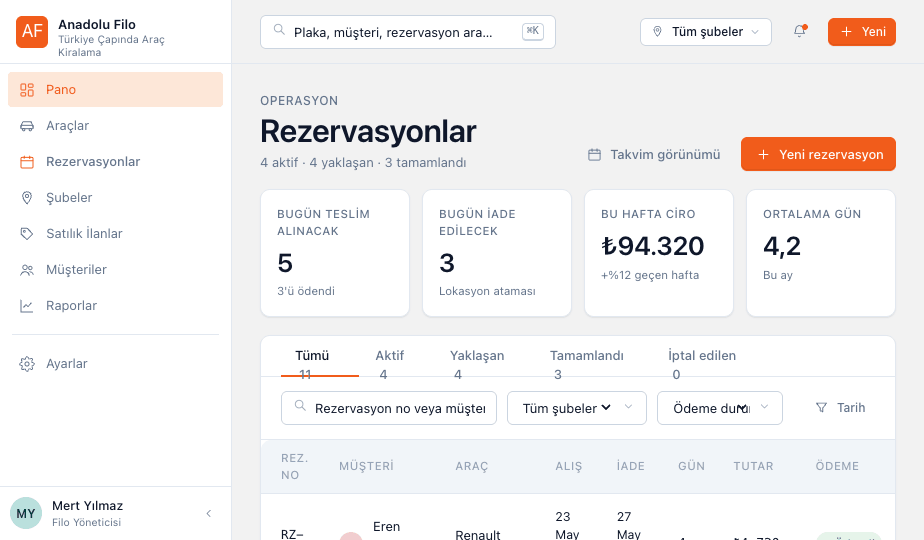
As the fleet grows, the question "which car is available, which is in service, which is on the road" becomes impossible to manage with a whiteboard. A good fleet panel shows each vehicle's status (available, rented, in maintenance) instantly; reminds you of maintenance, insurance and inspection dates; and reports how many days each vehicle spent occupied (utilization).
This visibility translates directly into profit. When you see in the data which vehicles are in high demand and which sit idle, you adjust your fleet composition and pricing accordingly. A managed fleet is always more profitable than a guessed-at one.
3. A brandable online storefront: selling under your own name
Being listed on big rental platforms is one channel; but there the customer remembers the platform, not you, and a commission goes out of every rental. An online storefront under your own brand, on your own domain, is yours: the customer finds you, rents directly from you, you pay no commission, and your brand value grows.
A good storefront presents your fleet with attractive visuals, shows prices clearly, and provides an easy "Rent Now" flow at every step. The site being findable on Google and smooth on mobile is the precondition for this channel to work; it needs to be built on a solid web and product foundation.
4. Digitalizing contracts, payments and operations
The unseen burden of the rental business is paperwork and operations: contracts, deposits, security deposits, handover-return reports, damage records. Running these on paper is both slow and leaves you weak in a dispute. In a digital flow, the contract is generated automatically, payment and deposit are taken online, and the vehicle's condition is recorded with handover-return photos.
This is not only speed, but also security. In a damage dispute, the photographed record at the moment of handover protects you. A deposit taken online lowers the no-show risk. Gathering all these records in one place eases both accounting and any potential disputes.
5. One panel: fleet, booking and sales together
When all these pieces — online booking, fleet status, branded storefront, contracts and payments — sit in separate tools, carrying the data between them by hand becomes a new burden. The real power lies in uniting them all in a single panel: a booking from the storefront is deducted from the fleet, the contract is generated, the payment is recorded, and the reports update automatically.
You can review the solutions and examples that do exactly this for car rental companies on our rent a car sector page. And the online experience being smooth for the customer is the direct result of good UI/UX design in the background.
In car rental, the winner isn't the one with the most cars; it's the company that turns its fleet over with the fewest idle days, the least paperwork and the most online sales. If you want to unite fleet, reservations and sales in one panel with a brandable storefront, let's talk about how to start with galeri and solutions tailored to you. Explore our rent a car solutions or get in touch.
Related Posts

An Online Booking System Guide for Travel Agencies
An online booking guide for travel agencies. Sell more tours with 24/7 booking, capacity management, online payments and an SEO-friendly agency website.

What Is an MVP? A Guide to Turning Your Idea Into a Working Product in 6 Weeks
What is an MVP and what isn't it? A realistic roadmap to turn your idea into a working product in 6 weeks: ruthless scoping, user validation and common mistakes.
9 Things to Know Before You Build a SaaS Product
9 critical things to know before you build a SaaS product: multi-tenant architecture, subscription billing, pricing, churn, security and the right tech partner.