An Online Booking System Guide for Travel Agencies
An online booking guide for travel agencies. Sell more tours with 24/7 booking, capacity management, online payments and an SEO-friendly agency website.

The owner of a travel agency once told us what happened on the busiest day of the season: for the same Cappadocia tour, two different employees, through two different channels (one by phone, one by WhatsApp), oversold beyond capacity. On the day of the tour, two guests couldn't board the bus, and the agency took both a refund and a reputation hit. On top of that, the dozens of "can I get a price?" messages that arrived after the office closed in the evening were left until morning — by which point most had already booked with another agency. The problem wasn't a lack of demand; it was the lack of a system to meet that demand.
Travel habits have changed. Today's traveler researches online first, reads the reviews, and wants to book the tour instantly if possible — even at midnight. A process that starts with a phone call and ends with "we'll get back to you" loses this fast-deciding customer. In this post we explain how a travel agency sells more tours with an online booking system, manages capacity with confidence, and turns its website into a sales channel.
Why is online booking essential now?
Buying a tour is no different from booking a hotel or a flight: people expect comparison, instant confirmation and a clear price. An agency that says "call during business hours" loses, from the outset, a large audience that decides outside those hours. And a significant part of that audience makes its decision within minutes; if they can't book right then, they move on to the agency in the next tab.
Online booking frees the agency from depending on "whoever happens to answer the phone." The system is open 24/7; it sells even while you sleep, deducts capacity automatically, and confirms instantly for the customer. It's the fastest way for a small agency to play on the same field as the big players.
In tourism, your rival isn't the agency that runs better tours; it's the one that can say "yes" to the customer one minute before you can.
1. 24/7 booking: selling even while you're closed
The most concrete return of online booking is that sales detach from working hours. The customer sees the tour, picks the date and number of people, pays the deposit and gets instant confirmation — all without you doing a thing. When the office opens in the morning, it finds the bookings that came in overnight ready and waiting.
This isn't just extra sales, it's also shifting your workforce to valuable work. Your team, who used to explain availability one call at a time and take notes manually, can instead focus on improving the experience, on corporate deals and on repeat sales.

2. Tour and capacity management: an end to double-booking
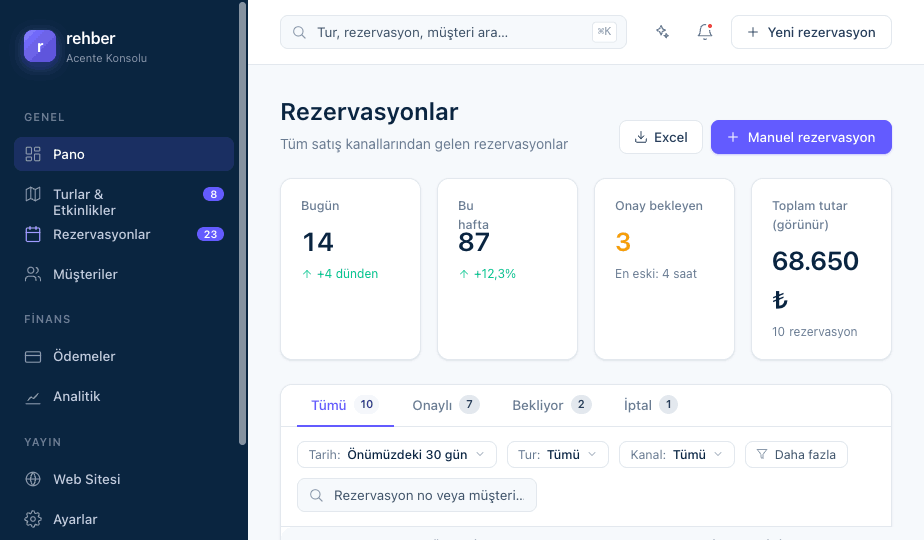
There's only one solution to the double-booking problem in the story: a single, central capacity. In an online system, each tour's capacity is defined, and every booking is deducted from it in real time. Even if sales happen simultaneously through two different channels, the system gives the last seat to one person; it updates the remaining capacity for everyone at once.
This central structure also lets you manage date-based tours, different departure points and pricing periods from one place. The answer to "how many spots are left this weekend?" is on your screen instantly, without calling anyone. Operational chaos gives way to a reliable, traceable system.
3. Securing bookings with online payment and deposits
The biggest risk of a booking taken verbally is the "no-show." Online payment or taking a deposit makes the booking concrete: a customer who has paid is far more likely to actually take the tour, and the no-show rate drops. What's more, when collection is digital, the till and the booking list reconcile automatically at the end of the day; the headache of manual reconciliation disappears.
Being able to set deposit and full-payment options by tour type both gives the customer flexibility and orders your cash flow. A secure, simple payment step directly raises the rate of completed bookings.
4. The agency website: the door to new customers
An online booking system is useless if the customer can't find you. That's why, in front of the system, there should be an agency website that's findable on Google, fast and mobile-friendly. Showing up for searches like "Cappadocia balloon tour" or "Black Sea tour prices" is free, high-intent traffic that arrives without you running ads.
A well-built agency site describes tours with attractive visuals, builds trust with reviews, and offers a clear "Book Now" step on every page. The site being fast and search-friendly isn't a luxury, it's directly a sales matter; it's something to attend to from the start on the web development side. And the customer having a smooth experience on their phone is the direct result of good UI/UX design.
5. Customer data and repeat sales
The quiet but biggest long-term return of an online system is customer data. Every booking tells you who was interested in which tour, and when. With this data, you can offer this year's new program to the guest who came on a winter tour last year; you can run a special campaign for the list that showed interest in a region. Finding a new customer is always more expensive than selling again to an existing one.
A structure that unites tours, bookings, customers and payments in one console makes this repeat-sales cycle possible. You can see the solutions and examples we've developed for agencies on our tourism sector page.
In the travel agency business, the difference isn't in making more phone calls; it's in building a system that can say "yes" to the customer at the moment and in the place they're looking. If you want to unite 24/7 booking, secure capacity, online payment and an SEO-friendly website in a single structure, let's talk about how to start with rehber and solutions tailored to you. Explore our tourism solutions or get in touch.
Related Posts

Online Booking and Fleet Management for Car Rental Companies
An online booking and fleet management guide for car rental companies. Prevent double-bookings, raise vehicle utilization and sell online with a brandable storefront.
Why Your Website Isn't Driving Sales (and How to Fix It)
Getting traffic but no sales? Here are the 7 most common reasons a website fails to convert — and the practical steps you can take to fix each one.
Core Web Vitals: Why Site Speed Decides Your Google Ranking
What are Core Web Vitals, and what do LCP, CLS and INP mean? We explain how site speed shapes your Google ranking and the practical ways to fix a slow site.